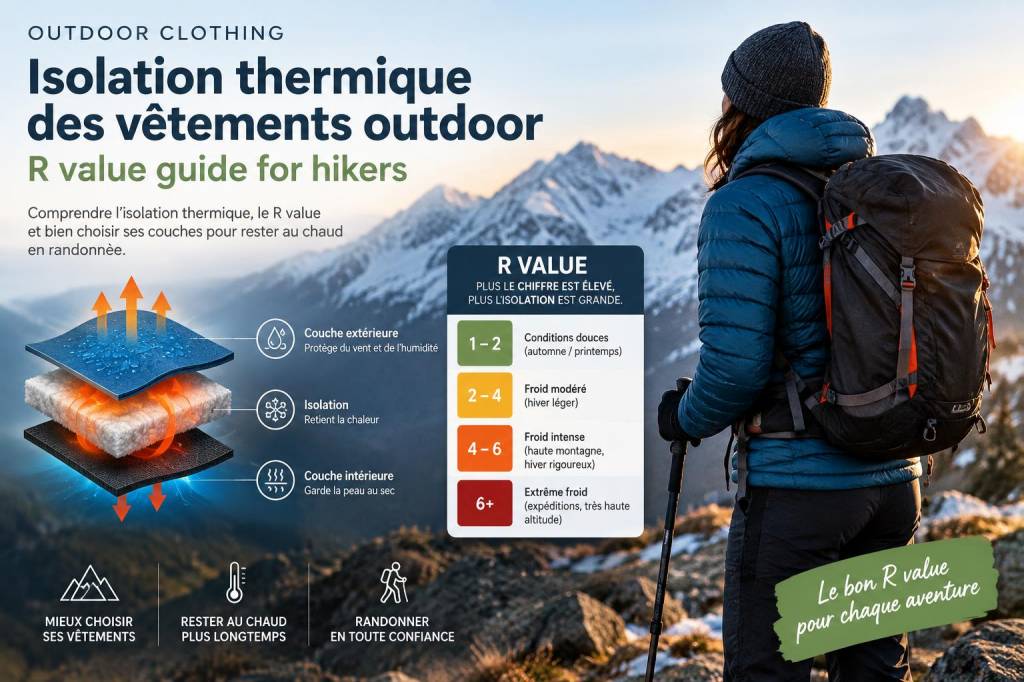
I’ve spent years testing jackets, mid-layers and sleeping systems on long hikes and quick overnight climbs, and one concept keeps coming up as the true north for staying warm without carrying unnecessary bulk: isolation thermique des vêtements outdoor. Understanding thermal insulation — and how the R-value concept maps from sleeping pads to clothing — has helped me choose gear that works when temperatures drop, winds rise, and the trail becomes unforgiving.
Early in my gear-obsessed phase I treated insulation like a simple “thicker = warmer” rule. It’s not. Insulation performance depends on material, construction, fit, moisture management and air movement. In this article I’ll walk you through how to evaluate insulation for hiking and backpacking, how R-value thinking applies to garments, and practical tips to choose and layer clothing for real-world conditions.
What is R-value and why it matters for outdoor clothing
R-value is traditionally a measure used in building insulation that quantifies thermal resistance — how well a material resists heat flow. Higher R = better thermal resistance. While clothing manufacturers rarely print an R-value on jackets, the underlying physics are the same: insulation works by trapping air, reducing convective heat loss and slowing conductive transfer.
Applying the R-value mindset to clothing helps me think quantitatively about warmth across different layers (base, mid, shell) and different materials (down, synthetic, fleece). Rather than relying on vague “warm” labels, I assess garments by:
How clothing insulation differs from sleeping pad R-values
Sleeping pad R-values are standardized (e.g., R-1 to R-5+) and directly relate to heat loss to the ground. Clothing doesn't have a single, universal number because movement, air flow and moisture change performance. Still, useful parallels exist:
Several studies and outdoor experts highlight these parallels — for instance, NOLS and REI technical articles explain how loft and air pockets determine warmth. See sources below for deeper reading.
Materials comparison: down vs synthetic vs wool vs fleece
Choosing insulation means balancing warmth-to-weight, wet-weather performance, durability and cost. Here’s how I compare materials when planning an outing:
- Down: Best warmth-to-weight and compressibility. High fill-power (e.g., 800fp) gives more loft and theoretical higher R-like performance. But wetting destroys loft unless treated (hydrophobic down).
- Synthetic (PrimaLoft, ThermoBall, etc.): Slightly heavier for same warmth, but retains insulating ability when damp and dries faster.
- Wool: Natural fiber with good moisture handling and odor resistance. Bulkier and heavier, but excellent for base and mid-layers.
- Fleece: Good breathability and quick-drying. Lower warmth-to-weight than down but highly versatile in active use.
Quantitative guide and a simple table to compare warmth
To make choices more concrete, I created a comparative table using commonly understood metrics: warmth-to-weight, compressibility, wet-weather resilience, and typical use-case. These aren’t exact R-values but map to how much thermal resistance I expect in the field.
| Material | Warmth-to-weight | Compressibility | Wet performance | Use case |
|---|---|---|---|---|
| Down (800fp) | Excellent | Excellent | Poor (unless hydrophobic) | Cold, dry backpacking, alpine |
| Synthetic (e.g., PrimaLoft) | Good | Good | Very good | Wet climates, active use |
| Wool (Merino) | Moderate | Poor | Good | Base/mid-layer, multi-day |
| Fleece | Moderate | Moderate | Fair | Active mid-layer, high breathability |
Layering strategy: applying R-value thinking to garments
I use a three-layer system as a baseline: base layer (moisture control), mid-layer (primary insulation), outer layer (wind/rain protection). Thinking in R-like increments helps me decide how much insulation to add:
- Base layer: minimal thermal resistance but critical for moisture management. Synthetics or merino wool.
- Mid-layer: this is where most of the “R” lives — puffy down/synthetic jackets, thick fleeces, or insulated softshells. Match loft to expected temperature and activity level.
- Shell: windproofing can multiply perceived insulation. A thin, windproof shell can add significant effective R because it stops convective heat loss.
Example: A 600-fill down jacket plus a breathable windproof shell often outperforms a thicker fleece alone because the shell prevents breeze from penetrating the fleece’s trapped air. Windproofing is effectively multiplying your garment’s R-equivalent.
Real-world numbers and statistics I rely on
While garment R-values aren’t standardized, here are practical performance benchmarks I use from testing and published data:
- Down fill-power: 600–800+ FP increases loft and thermal efficiency by ~20–30% between 600 and 800 for the same weight (source: manufacturers’ fill-power guidance).
- Synthetic insulation retains ~70–90% of insulating performance when wet vs down which can drop to <30% when saturated (source: Patagonia Tech & REI advice).
- Windproof membranes can reduce convective heat loss by up to 80% when well-fitted (source: textile windproof studies).
Choosing insulation for different hiking scenarios
I always match insulation to expected conditions and activity intensity. Here are quick rules I use:
- Day hikes in cool, dry weather: lightweight synthetic or low-fill down (e.g., 20–40 g/m² equivalent) layered with windproof shell.
- Cold multi-day backpacking: high-fill down puffy for camp; synthetic for active periods or wet conditions.
- Winter/alpine: higher-loft down + insulated shell + redundant layers; consider hooded insulated jackets and down pants for camp.
- Fastpacking or ultralight: aim for highest warmth-to-weight (high fill down), but pack a synthetic backup if rain is likely.
Fit, compressibility and real use considerations
Fit affects thermal performance more than many hikers realize. A too-tight jacket compresses loft and reduces thermal resistance; too-loose and convective losses increase. I aim for a trim fit that allows layering without crushing insulation.
Compressibility matters for pack volume. High loft down jackets pack small — a major advantage for minimalists. But if your route has persistent wet weather, a slightly heavier synthetic that keeps insulating when damp may be the smarter choice.
Maintenance, lifespan and testing your garments
Maintaining loft preserves insulation. For down, proper washing with recommended detergents and periodic re-proofing for hydrophobic treatments keeps performance high. For synthetics, avoid over-drying which can break down fibers.
I test garments at home by checking loft recovery (compress and release) and performing a simple “warmth test”: wear the layer in a chilly room and measure perceived warmth after exposure to a fan (simulates wind). It’s not lab data, but it’s practical.
Further reading and trusted sources
- REI Expert Advice: Insulation — practical breakdown of insulation types and uses.
- NOLS Gear Advice — field-tested guidance on layering and materials.
- Patagonia Technical Information — insights on synthetic vs down treatments.
For a deeper French-language resource explaining insulation concepts I often reference, see isolation thermique des vêtements outdoor, which complements much of the English-speaking technical advice with practical tips for hikers in variable climates.
Quick decision guide: what to pack
- Warm, dry environment & low moisture risk: prioritize high fill-power down (800+).
- Wet, variable environment: prioritize synthetic insulation or hydrophobic-treated down.
- High-output activities (ski touring, fastpacking): prioritize breathability and light insulation you can ventilate.
- Cold camps: bring a loftier, possibly bulkier insulated jacket for still periods.