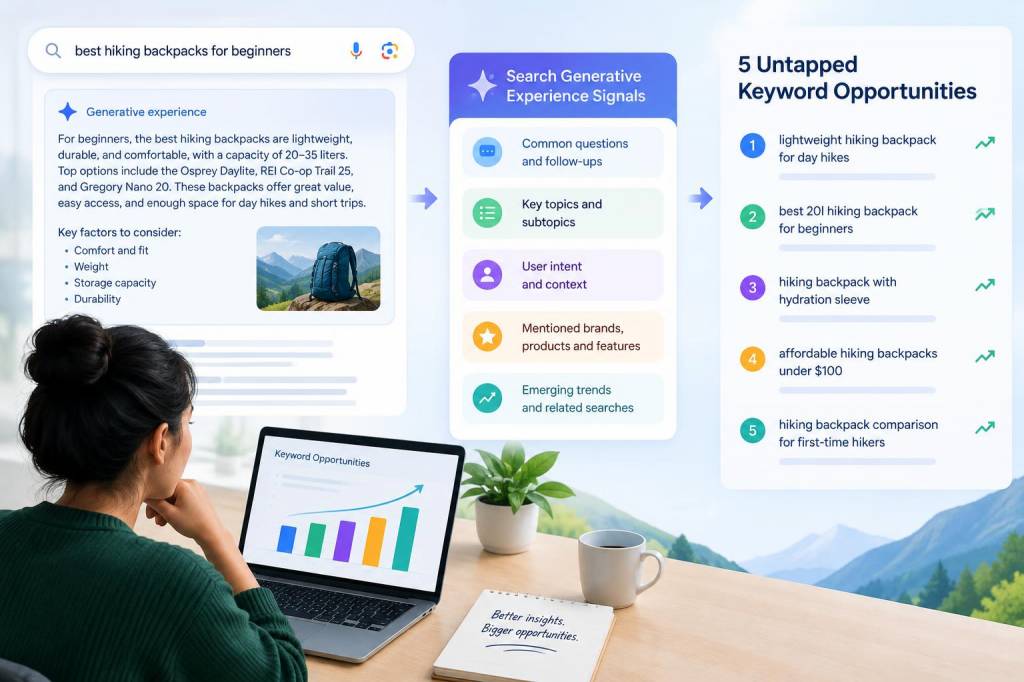
I’ve been experimenting with Google’s Search Generative Experience (SGE) since it launched, and one thing became clear quickly: the new signals that SGE surfaces are a goldmine for unearthing keyword opportunities that traditional keyword tools often miss. In this article I’ll walk you through how I use SGE signals to discover five untapped keyword opportunities, with practical steps you can reproduce for your own SEO strategy.
Understanding the SGE signals that matter
Before we hunt for opportunities, let’s clarify what I mean by “SGE signals.” These are the behavioral and interface cues Google exposes in the generative SERP: follow-up prompts, suggested refinements, the short generative answer itself, the cited sources and which sources are shown prominently, user-intent hints (e.g., transactional vs. informational), and follow-up click patterns. Unlike classic SERP features, SGE gives us conversational context—suggested follow-ups that represent how users naturally pivot during a search session.
To capitalize on these signals, I combine manual observation in the SERP with lightweight automation (think Puppeteer or SerpApi for scraping SGE outputs) and traditional SEO tools like Google Search Console, Ahrefs, and ChatGPT to cluster and prioritize opportunities.
My workflow: capture, cluster, validate, create
Here’s the practical process I use every time I explore SGE-driven opportunities:
Put simply: SGE tells you not only what users asked, but how they want to keep the conversation going. That’s the edge.
Five untapped keyword opportunities revealed by SGE
Below I list five opportunity types I consistently discover using SGE signals, with concrete examples and recommended content formats.
Signal: Suggested follow-ups appear under the generative answer (e.g., “How long does X last?” or “Is X safe for Y?”).
Why it’s valuable: These follow-ups are natural extensions of a searcher’s intent and often map to long-tail, low-competition queries that tools underreport.
How I exploit it: I build conversational FAQ pages and sectioned long-form posts that mirror the exact phrasing of follow-ups. I include schema (FAQ and QAPage where appropriate) and real-world examples. Example: for “knee pain causes,” an SGE follow-up might be “exercises to help knee pain after running”—a perfect long-tail article or video demo.
Signal: The generative answer cites sources but the snippet or linked article lacks depth on a subtopic the answer mentions.
Why it’s valuable: If the answer references a concept but the source only skims it, there’s a content gap you can fill with an authoritative, well-structured resource.
How I exploit it: I click the cited sources and read them carefully. If I find superficial coverage, I produce deep, practical content (case studies, step-by-step guides, downloadable templates). This is especially effective for B2B topics where users need actionable frameworks.
Signal: SGE presents follow-ups that indicate buying or comparison intent (e.g., “price of X 2026,” “X vs Y features”).
Why it’s valuable: These are high-conversion opportunities that often lack long-form content optimized for comparison or purchase decision support.
How I exploit it: I create comparison pages, up-to-date pricing guides, and interactive content (calculators, product finders). For ecommerce brands I work with, this approach often surfaces keywords where content can directly improve conversion rates.
Signal: The SGE result emphasizes visuals or step-by-step procedures and includes follow-ups like “show me a diagram” or “video tutorial.”
Why it’s valuable: Many sites still publish only text when users actually want visual walkthroughs—an easy gap to exploit.
How I exploit it: I produce short explainer videos, annotated images, and carousel posts optimized for both the page and YouTube/Instagram. Embedding a concise how-to video near the top of the article often improves dwell time and the page’s chance of being used as a source for SGE answers.
Signal: SGE follow-ups include location or niche modifiers (e.g., “best X for vegans in London” or “hourly rate for X in Yorkshire”).
Why it’s valuable: Many broader keyword tools don’t capture hyper-local or niche modifiers well, but SGE reveals that users are refining for locality and audience.
How I exploit it: I create location- or-audience-specific landing pages and FAQs. For example, converting a national “best plant-based restaurants” post into city-specific pages with curated lists and user reviews can unlock low-competition local traffic.
What tools and signals I use to scale this approach
I combine lightweight scraping and manual review with standard SEO tools. My toolkit looks like this:
Example table: mapping opportunity to content type
| Opportunity | SGE signal | Content to create | Why it works |
|---|---|---|---|
| Conversational long-tail | Follow-up prompts phrased as questions | FAQ sections, long-form Q&A, how-to posts | Matches searcher language and session flow |
| Source-gap | Generative answer cites shallow sources | In-depth guides, case studies, tools | Fills content gaps and becomes a preferred citation |
| Transactional micro-intent | Follow-ups with comparisons/pricing | Comparison pages, pricing guides, product finders | Captures high-intent, high-conversion queries |
| Multimedia intent | Follow-ups asking for diagrams or videos | Videos, infographics, step-by-step visual tutorials | Improves engagement and SGE citation potential |
| Local/niche modifiers | Location-specific follow-ups | Localized landing pages, curated lists | Targets underserved local demand |
SGE changes the way we see search sessions: not just isolated queries, but conversational journeys. When you pay attention to the follow-ups, the cited sources, and the format cues, you’ll find a steady stream of keyword opportunities that are both relevant and underserved. I use these insights daily for content planning at Marketing News (https://www.marketing-news.uk), and they consistently yield high-intent traffic and improved SERP presence.