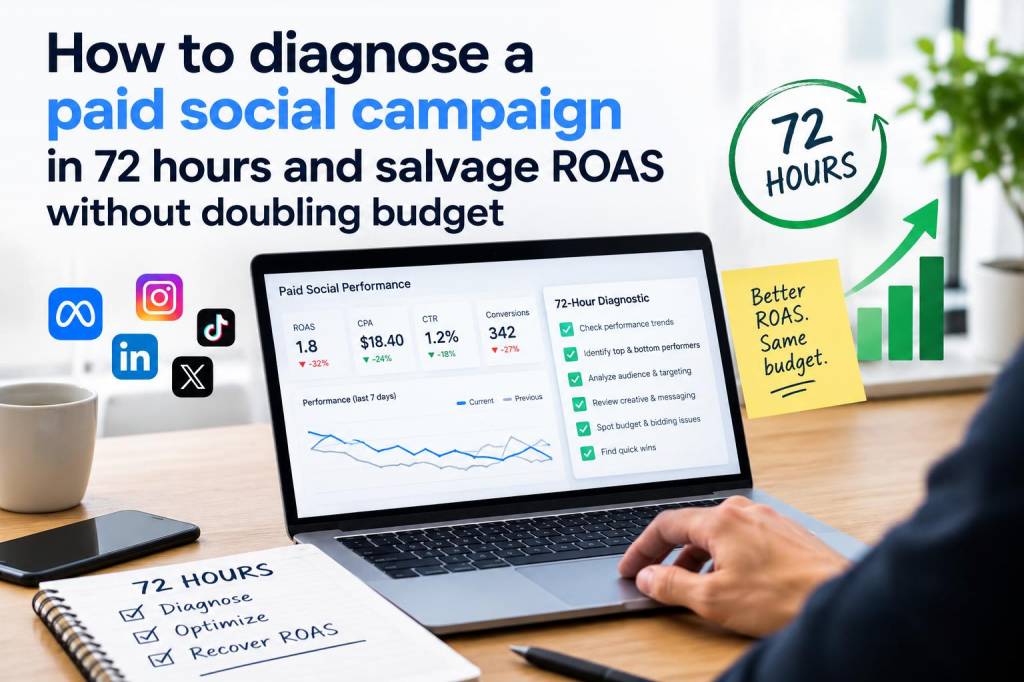
I’ve been in the trenches of paid social long enough to know panic spreads faster than a bad creative. When a campaign starts underperforming, your instinct might be to double the budget and hope the algorithm salvages your ROAS. I’ve learned the hard way that throwing money at the problem rarely fixes the root cause. Instead, there’s a methodical 72-hour triage that can diagnose issues and often revive performance without increasing spend. Here’s exactly how I approach it.
Hour 0–4: Calm the noise and gather the facts
The first thing I do is stop adding variables. No new audiences, no new creatives, no budget changes. I pull the last 14–30 days of data and a high-level snapshot of the last 72 hours.
Top metrics to collect immediately: CTR, CPC, CPM, Conversion Rate (CVR), Cost Per Conversion, ROAS, Frequency, Impressions, Clicks, Landing Page Load Time, and Pixel/GTAG activity.Platform checks: Is there a notification from Meta (Facebook/Instagram), TikTok, or LinkedIn about policy restrictions? Any ad disapprovals or delivery issues?Tracking sanity: Confirm conversions are firing correctly in Events Manager, GA4, or your server-side setup. A sudden drop in reported conversions often signals tracking breakage rather than audience fatigue.When I first ran campaigns for a DTC client, their ROAS tanked overnight. It turned out the web developer had accidentally removed the conversion pixel during a site update. Fix the data pipeline first — without reliable data, every decision is guesswork.
Hour 4–12: Isolate which part of the funnel is failing
Split your diagnosis into three buckets: creative/ad experience, audience targeting, and conversion flow. For each, identify whether the problem is at awareness (CTR), consideration (landing page engagement), or conversion (checkout/lead form).
Creative/ad experience: Low CTR with high impressions often points to creative fatigue, poor messaging, or wrong value proposition. Check the best and worst performing ads — are there common elements (imagery, copy, CTA) in the losers?Audience targeting: Rising CPC and falling CTR can also indicate audience saturation. Look at frequency; once frequency exceeds ~3–4 for prospecting audiences, performance often degrades.Conversion flow: If clicks are steady but conversions drop, inspect landing pages, mobile vs desktop performance, and form errors. Use heatmaps or session recordings (Hotjar, FullStory) to spot friction.Hour 12–24: Quick fixes you can deploy immediately
These are low-risk, high-speed actions that don’t require budget increases but can reverse negative trends.
Creative refresh: Pause the worst-performing 20–30% of ads and swap them with 2–3 fresh variations. Use the same creative concept but rotate the hero image, headline, or CTA. Small tweaks often reset the algorithm’s learning.Audience pruning: Reduce overlap by excluding high-conversion remarketing lists from prospecting sets. Add negative audiences for recent purchasers.Landing page quick wins: Improve above-the-fold clarity: ensure the headline matches the ad promise, load times are under 3 seconds, and the CTA is visible. If your checkout flow shows drop-offs, re-enable any simplified checkout options temporarily.Bid/optimization adjustments: If automatic bidding is oscillating, switch to manual CPC or target CPA cap for 24–48 hours to stabilize delivery. I usually lower bids slightly rather than raise them; you want to prevent overspending for low-quality traffic.Hour 24–48: Deeper diagnostics and experiments
Now that you’ve stabilized the campaign, run controlled experiments to find the lever that moves ROAS.
Creative A/B tests: Run a structured A/B test: keep audience and placement constant, test 2–3 creatives, and let them run until statistically significant (or for 48 hours minimum if budgets are limited).Audience expansion vs refinement: Test a narrower, high-intent audience against a broader lookalike. For example, if you’re on Meta, compare 1% lookalike of purchasers vs. a 3% lookalike with interest layering.Placement & device split: If mobile conversion rate collapsed, test mobile-only vs desktop-only. You might find desktop still converts well, letting you reallocate spend efficiently.Attribution verification: Reconcile platform-reported conversions with backend or CRM numbers. Discrepancies here can mislead optimization.Hour 48–72: Optimize and scale carefully
With initial learnings, it’s time to optimize intelligently rather than reactively.
Allocate to winners: Increase budget incrementally to top-performing ad sets — usually no more than 20–30% every 48–72 hours to avoid disrupting learning phases.Consolidate creatives: Keep only the top-performing 2–3 creatives per ad set to reduce audience fragmentation. This helps the delivery algorithm learn faster.Retarget smarter: Compress retargeting windows (e.g., 7–14 days) for users who visited but didn’t convert, and use dynamic messaging that references their behaviour (product viewed, cart abandoned).Introduce scarcity or offers: Time-limited discounts, free shipping thresholds, or bundled offers can boost conversion rate without increasing acquisition cost. Test messaging variants to avoid margin erosion.Quick reference 72-hour timeline
| Time | Priority | Action |
|---|
| 0–4h | High | Gather metrics, check pixel/notifications, stop changes |
| 4–12h | High | Identify funnel failure point (creative/audience/flow) |
| 12–24h | Medium | Deploy quick fixes: pause worst ads, swap creatives, minor bid changes |
| 24–48h | Medium | Run controlled A/B tests, check placements, device split |
| 48–72h | High | Scale winners slowly, compress retargeting, optimize messaging |
Common pitfalls I avoid
Over-optimization: Changing too many variables at once. You need control to know what worked.Chasing last-click attribution blindly: Platforms and CRMs will differ. Use multi-touch insight and credit backend revenue when possible.Ignoring creative fatigue: Creative decay is the single most common silent killer. Rotate often and plan a creative calendar.One of my favorite real-world wins came from a SaaS client: by isolating the problem to a confused landing experience and swapping to a demo-first CTA, we improved CVR by 38% in three days and raised ROAS without increasing spend. The change wasn’t dramatic — just clearer messaging and a faster path to value.
If you want, I can give you a checklist template to run this 72-hour audit on your campaigns, or walk through a live example with your metrics and creatives. Tell me which platform you’re using (Meta, TikTok, LinkedIn, X), and I’ll tailor the steps to fit that ecosystem.