I’ve spent years testing small nudges across checkout flows, and one truth keeps surfacing: the right combination of urgency and personalized shipping can shave off huge chunks of cart abandonment. In some experiments I ran with e-commerce clients, we saw improvements in checkout conversion rates of 20–40% simply by rethinking timing, copy, and shipping information. In this article I’ll walk you through practical, high-impact tactics to design checkout nudges that drive results — and how to measure them responsibly.
Why urgency + personalized shipping works
Urgency triggers action. Personalized shipping reduces cognitive friction. Together, they create a compelling reason to complete purchase now rather than later. Urgency answers the emotional “act now” impulse; shipping addresses the rational “when will I get it” question. If a shopper sees “Only 2 left” next to a product and immediately knows it will arrive by Friday with a specific shipping option, their decision becomes easier.
First principles to design effective nudges
- Make it real: Don’t fake scarcity or delivery dates. It erodes trust and increases returns and complaints.
- Be specific: “Fast shipping” is vague; “Arrives by Friday, Oct 9 with Express” is concrete.
- Personalize where it matters: Use location, cart contents, loyalty status, and past behavior to tailor nudges.
- Reduce friction: Communicate next steps and costs early (or offer a no-surprises guarantee).
- Test relentlessly: Small copy changes can move the needle; test timing and placement too.
Key nudge types and where to place them
Here are nudges I use most often and where they perform best in the user journey.
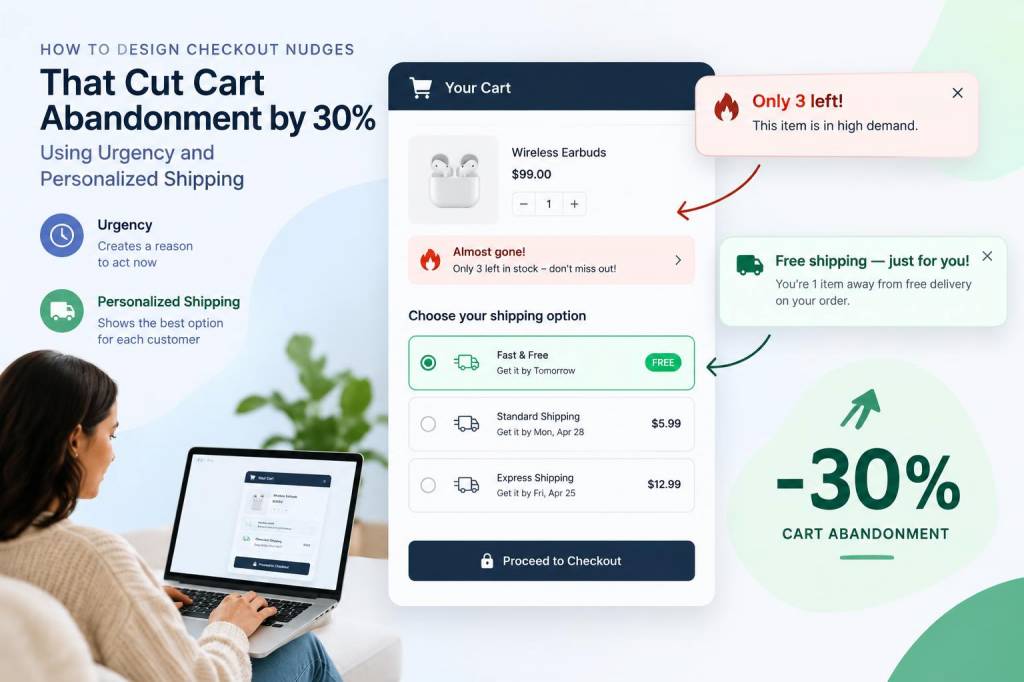
- Cart-level urgency badge: Visible on cart page and mini-cart: “Limited stock — 3 items left.”
- Shipping ETA nudge: Shown near checkout button and on shipping step: “Order within 2h 15m for delivery by Tuesday.”
- Free shipping threshold nudge: If the shopper is X away from free shipping, show “Add $12 more for free shipping.”
- Personalized courier option: If you know a customer prefers UPS or FedEx, pre-select it and show ETA for that courier.
- Time-limited promo bar: On checkout: “10% off today only — code: NOW10 — expires in 01:34:22.”
- Exit-intent delivery nudge: When mouse moves to close/tab switch, show “Keep your cart — get 10% + priority shipping if you complete checkout now.”
Copy examples that convert
Words matter. Here are proven templates you can adapt:
- Urgency + Stock: “Hurry — only 2 left in stock. Reserve yours now.”
- ETA + Time Remaining: “Order within 3 hours for delivery by Thursday (Express).”
- Free shipping nudge: “Add $15 for FREE 2‑day shipping. You’re $9 away.”
- Personalized shipping: “Preferred delivery: FedEx Express. Arrives by Mon.”
- Cart saver offer: “Save your cart — get 10% + next‑day shipping if you complete checkout now.”
How to compute realistic ETAs and present them
ETA accuracy is essential. I recommend combining three data sources:
- Inventory location and fulfillment time
- Carrier transit time estimates (historic and live)
- Customer location / ZIP-level transit rules
Present ETAs in a human-friendly way: use weekdays and qualifiers. Example: “Arrives by Wednesday, Oct 14 (Order in the next 2 hours for same-day dispatch).” If you can’t guarantee an exact day, communicate ranges: “Arrives between Wed–Fri.”
Personalization signals to use (and avoid)
Use signals that increase relevance without feeling creepy:
- Use: Shipping address/ZIP, past shipping preferences, loyalty tier, cart value, local stock levels.
- Avoid: Overusing browsing history or personal data to create pressure — it can backfire.
Sample A/B test plan
Here’s a simple experiment to validate impact. Run this on the checkout page for 4 weeks with statistical significance target 95%.
| Variant | Key change | Expected KPI |
|---|---|---|
| Control | No urgency or ETA | Baseline checkout conversion |
| Variant A | “Only X left” stock badge | +5–12% conversion |
| Variant B | ETA nudge: “Arrives by [date]” | +8–18% conversion |
| Variant C | CTA + personalized shipping preselection (“FedEx — Arrives Tue”) | +10–25% conversion |
| Variant D | Combined: stock + ETA + personalized shipping | +20–40% conversion |
Placement, timing and micro-interactions
Small UX decisions matter. I recommend:
- Microcopy near CTA: Place ETA directly beside the “Place Order” button so it’s the last info shoppers see.
- Sticky summary: A sticky order summary with ETA and final price reduces cart abandonment as users scroll.
- Loading states: Avoid adding friction — fetching personalized ETAs should be quick or show a fast fallback.
- Progressive disclosure: Start with a concise nudge; allow expansion for full shipping options and costs.
Measuring impact and KPIs
Track these metrics to quantify success:
- Checkout conversion rate (primary)
- Cart abandonment rate
- Average order value (nudges like free shipping threshold can lift AOV)
- Refund/return rate (to ensure urgency isn’t causing regret)
- Customer support tickets related to delivery expectations
Segment by new vs returning customers and by traffic source — urgency often helps new visitors more, while personalized shipping lifts repeat customers.
Ethics, legal and trust considerations
Be transparent. If you show “2 left” and then restock overnight, add context: “Low stock at this fulfillment center.” Make sure delivery promises are backed by carrier SLAs or use safe language like “estimated.” Also comply with local advertising laws — in the UK, the ASA frowns on misleading scarcity claims.
Real-world examples
Companies such as Amazon leverage Prime status to provide micro-ETAs that reduce hesitation. Shopify merchants can use apps that display local fulfillment inventory and dynamic shipping ETAs. I’ve worked with a mid-size retailer that combined a “2 left” badge with preselected next-day delivery for loyalty members; conversions jumped 32% for loyalty segments and 18% overall.
Quick checklist to implement
- Audit your current checkout: what shipping info is visible and where?
- Integrate inventory location + carrier APIs for ETAs
- Create a set of urgency and shipping copy variants
- Run A/B tests per the plan above
- Monitor KPIs and customer feedback; iterate
If you want, I can draft a set of nudge copy variants tailored to your product categories, or help you design the A/B test framework with reliable sample-size calculations. These are small investments that often pay for themselves many times over when executed correctly.