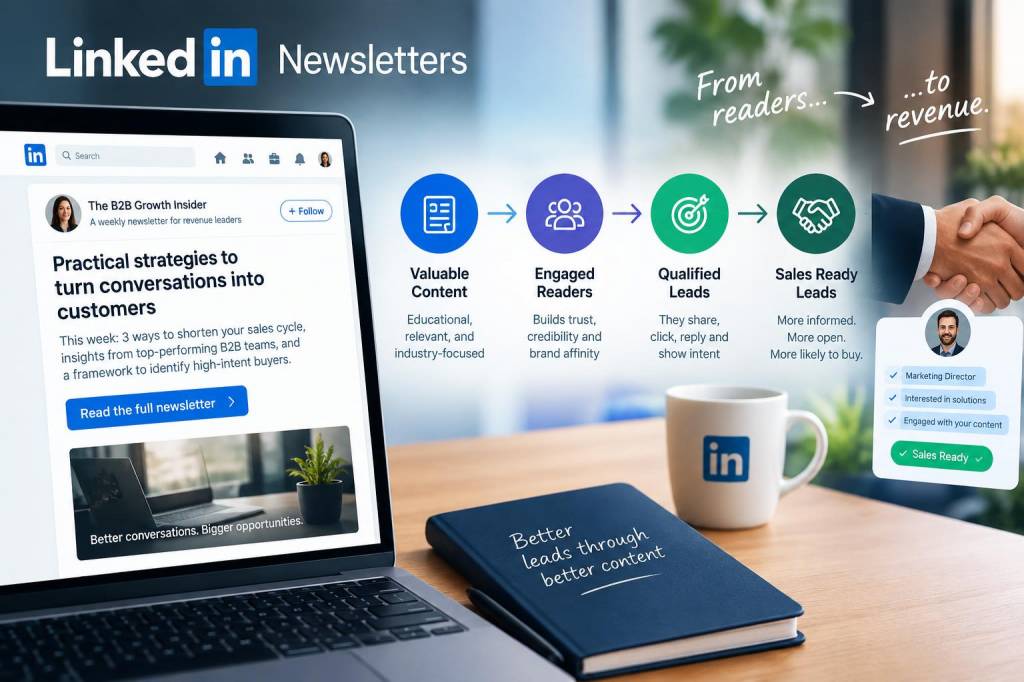
LinkedIn newsletters have become one of my favorite B2B content assets because they do something many channels struggle to do at once: they attract attention, build trust, and move readers closer to a buying decision. When I look at why some newsletters create sales-ready leads while others only collect casual subscribers, I usually find a simple pattern. The strongest newsletters do not try to impress everyone. They speak directly to a specific business problem, deliver useful insight with consistency, and create a natural bridge from learning to action.
Why LinkedIn newsletters feel different from ordinary social content
What I appreciate about LinkedIn newsletters is that they sit closer to intent than most social posts. A feed post may earn a quick reaction, but a newsletter subscription is a small signal of commitment. Someone is not just scrolling past a thought; they are saying, “I want more from this person or brand.” In B2B, that matters a lot because buying decisions usually involve research, internal alignment, and trust-building over time.
From my experience, newsletters convert better when I treat them less like broadcast content and more like an ongoing relationship. LinkedIn gives me a built-in distribution channel, but distribution alone is not enough. Conversion happens when readers feel that every issue helps them do their job better, make a smarter decision, or avoid a costly mistake. Once that feeling is established, moving from reader to lead becomes much easier.
Relevance beats volume every time
One of the biggest reasons LinkedIn newsletters convert B2B readers into sales-ready leads is relevance. B2B audiences are busy, and they ignore vague content very quickly. If I write about broad marketing trends without connecting them to a specific buyer challenge, engagement may look fine on the surface, but lead quality stays low. If I focus on a painful, practical issue, I attract readers who already care about solving it.
I have found that a clear niche increases both trust and conversion. For example, a newsletter about “marketing” is too broad. A newsletter about “demand generation for mid-market SaaS teams with long sales cycles” immediately signals usefulness. That kind of specificity helps readers self-select. The people who subscribe are more likely to match my audience, and they are more likely to continue reading because the content feels personally relevant.
Relevance also improves the sales conversation later. When a reader keeps seeing advice that reflects their reality, I am not introducing my offer from zero. I am continuing a discussion they already recognize as useful.
Consistency builds familiarity, and familiarity builds trust
I rarely see strong lead conversion from a newsletter that appears once in a while with no clear rhythm. Consistency matters because trust grows through repeated exposure. When readers know what to expect from me, they begin to recognize my perspective, my priorities, and my voice. That familiarity lowers resistance.
In practice, this means I need a publishing rhythm I can sustain. I do not need to send an issue every day. In fact, I think weekly or biweekly often works better for B2B audiences because it gives enough time for meaningful insight. What matters is reliability. If I publish on a regular schedule, readers start to make room for my newsletter in their routine, and that habit increases the chance that they will eventually respond to an offer, book a call, or request more information.
Consistency also signals professionalism. In B2B, buyers often assume that a brand that cannot maintain a steady communication cadence may also struggle with service quality or follow-through. A well-run newsletter quietly reinforces the opposite message.
Useful education moves readers closer to purchase
I never want a newsletter to feel like a thinly disguised sales pitch. Readers can sense that immediately, and once they do, trust drops. What works far better is education that genuinely helps. When I explain a framework, share a useful example, or break down a process in plain language, I create value before asking for anything.
This is where many newsletters miss an opportunity. They offer inspiration, but not enough practical direction. A reader may enjoy the article and still have no idea what to do next. When I include actionable insight, I help the reader apply the lesson internally. That application creates momentum, and momentum is what turns curiosity into buying intent.
For example, if I write about improving B2B lead quality, I might explain how to segment audiences, measure engagement by role, or compare content performance across funnel stages. Those details are not just educational. They help readers recognize gaps in their own process. Once they identify a gap, they are much more open to a solution.
A newsletter converts better when it sounds human
I have noticed that many B2B brands still sound too polished, too distant, or too generic. LinkedIn newsletters work better when the writing feels human. That does not mean informal or sloppy. It means clear, direct, and honest. Readers want to hear from a person who has thought about their challenge, not from a marketing machine that has copied a trending angle.
When I write in a human voice, I create a stronger emotional connection. I can share what I have seen, what I have learned, and where I have changed my mind. That openness matters because B2B buyers do not only buy information; they buy judgment. If I sound thoughtful and grounded, readers begin to trust my judgment.
I also think honesty about nuance helps conversion. Strong readers do not want oversimplified claims. If something depends on company size, budget, sales cycle, or team maturity, I say so. That level of honesty makes the content more credible, and credibility is a major conversion factor.
The call to action must fit the reader’s state of mind
One of the most important lessons I have learned is that a newsletter converts better when the call to action matches the reader’s current level of interest. If I ask for a high-commitment action too early, I lose people. If I ask for nothing, I miss the opportunity to move them forward.
I prefer calls to action that feel like a logical next step. A reader who has just learned something valuable may not be ready for a sales call, but they may be ready for a checklist, a webinar, a short diagnostic, or a case study. Those offers feel useful rather than pushy. They also give me a chance to learn more about the reader’s intent.
Here is a simple way I think about it:
- Low intent: subscribe, save, or share the issue
- Medium intent: download a resource, join a session, or read a case study
- High intent: request a demo, book a call, or start a trial
The strongest newsletters do not force everyone into the same action. They offer a path that fits different levels of readiness.
Data helps me improve conversion without losing voice
I rely on data, but I do not let data turn the newsletter into a sterile experiment. I watch open behavior, click behavior, subscription growth, and downstream lead quality. Those signals tell me which subjects resonate, which offers attract qualified readers, and which formats keep attention. Still, numbers alone do not explain everything. I also pay attention to the questions people ask, the replies they send, and the objections that appear in sales conversations.
When I combine quantitative and qualitative feedback, I get a much clearer picture of what converts. Sometimes an issue with modest engagement creates excellent leads because it speaks to the right people. Sometimes a highly shared issue attracts a broad audience that never buys. If I only chase surface metrics, I may optimize for popularity instead of pipeline.
That is why I like to review newsletter performance in relation to downstream behavior. I want to know which topics produce meaningful conversations, not just clicks. A smaller but more qualified audience is often much more valuable than a large audience with little purchase intent.
Story and proof matter more than empty claims
Readers trust newsletters that show evidence. I do not need to overload every issue with statistics, but I do need to support my ideas with real examples. Story helps people understand why a concept matters, and proof helps them believe that it can work.
When I share a client pattern, a campaign lesson, or a mistake I made and corrected, the newsletter becomes more believable. B2B readers are especially responsive to proof because they are often making decisions that affect revenue, team time, and executive confidence. They want reassurance that the advice is not just clever but usable.
I also think it helps to show a process instead of just a result. A reader may admire a successful campaign, but if I explain the thinking behind it, they can picture using a similar approach themselves. That practical transfer is where conversion begins.
Where newsletters fit in a broader B2B journey
I see LinkedIn newsletters as one part of a larger trust system. They work even better when they connect to a landing page, a lead magnet, a webinar, a case study, or a sales conversation that continues the same message. In other words, the newsletter should not stand alone. It should act as a bridge.
When I map the journey carefully, I can move readers from awareness to interest without creating friction. A newsletter issue may introduce a problem, a follow-up asset may explore the problem in more detail, and a sales page may offer a direct solution. That sequence works because each step feels like a natural continuation of the last one.
In my view, LinkedIn newsletters convert B2B readers into sales-ready leads when they combine relevance, consistency, useful education, a human voice, and a next step that matches intent. That mix turns attention into trust, and trust into action.
| Newsletter element | Conversion impact | My focus |
| Specific topic | Attracts qualified readers | Speak to one clear business problem |
| Regular publishing | Builds familiarity | Maintain a rhythm I can sustain |
| Practical insight | Creates value and momentum | Teach something usable in every issue |
| Human voice | Strengthens trust | Write with clarity, honesty, and personality |
| Relevant call to action | Moves readers forward | Match the offer to reader readiness |
What I find most rewarding is that a strong LinkedIn newsletter does more than generate leads. It creates a conversation with the right audience over time. And in B2B marketing, that ongoing conversation is often what turns a curious reader into someone genuinely ready to buy.