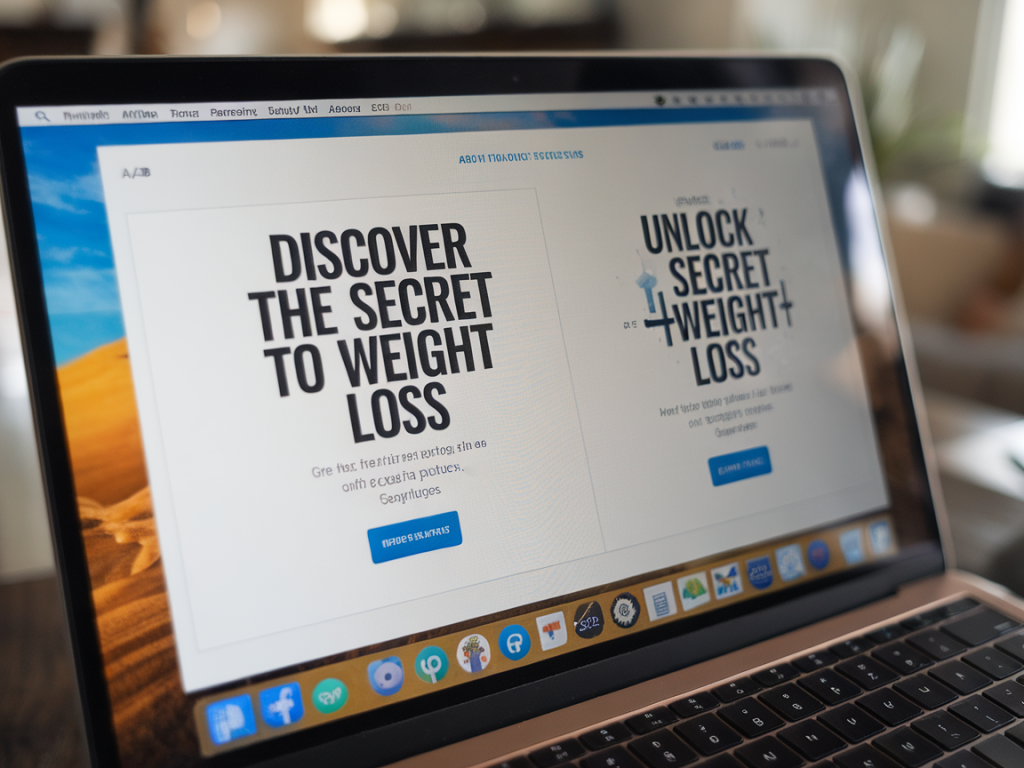
I’ve seen countless landing pages that look great but quietly bleed conversions. When your page converts below 5%, the problem isn’t always creative taste or bad traffic — it’s often one high-impact element that’s out of sync with visitor intent. When you’re staring at low conversion rates, you don’t have the luxury of running dozens of tests at once. You need an A/B test that gives clear directional insight fast and that you can act on.
My single first A/B test: change the page’s primary value proposition (headline + subheadline)
If I have to pick one test to run first, it’s swapping your headline and supporting subheadline to a version that directly speaks to the visitor’s intent and benefit — not features. Why? Because the headline is the fastest way to confirm whether you’re communicating the right promise to the right people. It’s what visitors see first, and it determines whether they stay to learn more or bounce.
This test is low-friction, high-impact, and typically delivers a meaningful lift (or a clear fail) within a relatively small sample size. It also helps you diagnose whether the underlying issue is messaging rather than UX or traffic quality.
How I structure the headline/subheadline test
Here’s the process I use when I run this test:
Start with a clear hypothesis: "Visitors drop off because they don't immediately understand the primary benefit." The variant should explicitly state the benefit in plain language and, if possible, include a quantifiable result.Write 2–3 strong headline variants. One should be benefit-led, another should be problem-led, and a third could be social-proof-led (e.g., "Join 10,000+...").Keep other elements static. Don’t change hero image, CTA color, form fields, or layout during this test. We want the headline to be the only meaningful variable.Run the test long enough to reach statistical confidence, but don’t over-wait. For low volumes, aim for at least 1,000 visitors or a minimum of two full business cycles (e.g., two weeks) so weekday/weekend behavior evens out.Measure micro-conversions as well: scroll depth, time on hero, clicks to secondary content. These help when final conversions are rare.Record qualitative feedback: add a one-question on-exit survey or session recordings (Hotjar, FullStory) to understand why visitors leave.I almost always include a quantitative phrase if a real number exists: "Save up to 30% on ad spend" or "Close deals 2x faster." Specifics reduce cognitive friction and build credibility — but only use numbers you can back up.
What success/failure of this test tells you
If a benefit-led headline wins significantly: your traffic is relevant but your original messaging missed the mark. Update the page and iterate deeper (CTA, proof points).If no headline wins or the change has minimal impact: it suggests the issue is not messaging but UX, offer value, pricing, or traffic quality. Then pivot to a different A/B test.If the problem-led headline wins: visitors come with a pain point in mind. Rework the landing journey to validate and solve that pain faster (FAQ, case studies, risk reversal).When to move on: the next tests if headline changes don't fix <5%
If the headline test doesn’t bring conversions above 5%, run these prioritized tests next — each is chosen to diagnose a different root cause:
CTA text and placement: Test benefit-focused CTAs ("Get your free ROI plan") vs generic ones ("Get started"). Also test secondary sticky CTAs vs only above-the-fold CTA.Form length and friction: For lead-gen pages, reduce required fields. Test multi-step forms vs single long forms. Ask only what you need to qualify the lead.Hero image or video: People connect with faces, use-cases, or product-in-context. Test a human hero shot vs product screenshot vs explainer video.Social proof and trust signals: Add customer logos, short testimonials with metrics, security badges, or press mentions. Test presence vs absence.Pricing or offer clarity: If your page offers a paid product, test transparent pricing vs “contact us” funnels. For trials, test free trial length or money-back guarantees.Traffic segmentation tests: Sometimes conversion is under 5% because traffic mixes incompatible audiences. Run targeted variants per acquisition source (organic vs paid vs social) to match messaging to intent.Example test matrix I use when conversions are low
| Priority | Test | What it diagnoses | Quick win likelihood |
| 1 | Headline + subheadline | Messaging/fit with intent | High |
| 2 | CTA copy & placement | Clarity of next step | Medium |
| 3 | Form length (reduce fields) | Friction/lead quality balance | High for lead-gen |
| 4 | Social proof | Trust/credibility | Medium |
| 5 | Hero image/video | Emotional relevance | Low–Medium |
Practical examples
Here are a couple of concrete variants I’ve tested on real pages:
Original: "All-in-one Marketing Platform for Growing Teams" (converts 3.2%)Variant A: "Reduce customer acquisition costs by 25% in 30 days — For startups" (converts 6.1%)Variant B: "Marketing automation that frees 8 hours/week for your team" (converts 4.8%)Result: Variant A won. Why? It targeted a very specific outcome (lower CAC) and timeframe (30 days). The visitors were testing tools to cut ad spend; the original headline was too generic and abstract.
Tips to speed up learning
Use session recordings to watch the first 10 seconds of frustrated visitors — often the issue is obvious (no value, confusing CTA, bad image).Segment by traffic source. Paid social often needs emotional, benefit-led copy; search traffic tends to respond to functional clarity and matching the search phrase.Keep your experiments small. Big page redesigns create many variables and muddy learnings.Document everything. Keep a simple test log: hypothesis, variant copy, sample size, result, learning. This becomes your conversion playbook.When a landing page converts below 5%, your first job is to validate whether visitors understand and believe your offer. Tweak the headline and supporting promise first — it's the fastest way to find product/market messaging misalignment. From there, iterate logically: reduce friction, add trust, test CTAs, and align content by traffic source. Small, prioritized tests beat big, unfocused experiments when conversion rates are that low.