I used to think post-purchase communication ended the moment the package left the warehouse. Then I started paying attention to the customers who never returned: they’d buy once, vanish, and slowly inflate my churn numbers. That's when I turned to post-purchase SMS sequences in Klaviyo — not as a single follow-up text, but as a thoughtful sequence designed to reduce churn, build habit, and create repeat buyers.
Why post-purchase SMS matters for churn
SMS has unmatched open rates and immediacy. While email is great for deep content, SMS gets read — fast. When you combine that immediacy with behavioral data from Klaviyo (what someone bought, when they bought it, and their purchase history), you can send the right message at the right time to prevent one-time buyers from becoming lost customers.
From my experience, churn often stems from two things: lack of product engagement (customers don’t see value quickly) and lack of reminders (they forget to reorder or replace). Post-purchase SMS can tackle both by prompting usage, offering tips, and setting up future reorders or replenishment reminders.
Key elements of an effective post-purchase SMS sequence
Timing: The first message should confirm the purchase and set expectations (delivery, tracking). Follow-ups should align with product usage cycles — for example, a skin-care product might need a "how to use" text within 3–5 days, and a replenishment reminder at 30–60 days.Personalization: Use Klaviyo’s dynamic tags to include product names, order numbers, or first names. Personalized SMS performs noticeably better than generic copy.Value-first messages: Don’t only push discounts. Offer setup tips, product hacks, or user-generated content that helps them succeed with the product.Clear CTAs: Each SMS should have a single action: track your order, leave a review, reorder, or view a how-to video.Segmentation: Different sequences for first-time buyers vs returning customers, high-value customers vs occasional shoppers, and by product category (consumables vs durable goods).Measurement: Track conversion rates, reorder rates, opt-out rates, and long-term LTV for customers who went through the sequence.How I build the sequence in Klaviyo
I build flows in Klaviyo that are triggered by events and enriched by profile properties. Here’s a typical structure I implement:
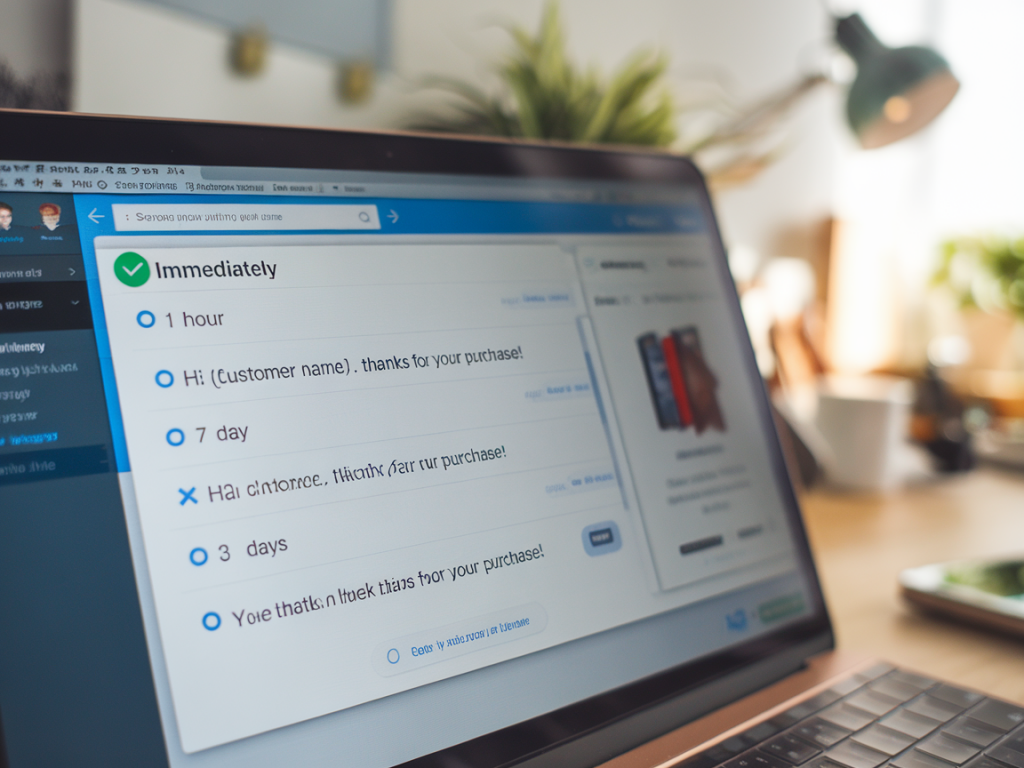
Immediate confirmation (0–1 hour): SMS confirming order and linking to tracking — soft, reassuring tone.Shipping notification (when shipment occurs): Tracking number, expected delivery date, and a short “what to expect” tip.Delivery check-in (1–2 days after delivery): Friendly check-in asking if everything arrived and offering a link to FAQs or quick help.Usage tips (3–7 days after delivery): Product-specific tips to drive successful first experience — often links to a short how-to video or a “top 3 tips.”Social proof & review request (10–14 days): Ask for a review and provide social proof. Offer an incentive for a review if it fits your brand voice.Replenishment or upgrade prompt (variable): Based on typical product lifetime, trigger reminders to reorder. For consumables I use predicted replenishment times; for apparel I suggest complementary products.Winback / loyalty prompt (45–90 days): For customers who haven’t returned, present a personalized offer or highlight new arrivals that match previous purchases.Practical SMS templates I use (short & tested)
Below are short templates that work well. Always keep local compliance and opt-in transparency in mind.
Order confirmation: “Hi {first_name}, your {product_name} order #{order_number} is confirmed. We’ll text when it ships. Track: {tracking_link}”Delivery check-in: “Hi {first_name} — did your {product_name} arrive ok? Reply YES for help or NO to connect with support.”Usage tip: “Pro tip for {product_name}: {one_short_tip}. Watch a 60s demo: {link}”Review request: “Loved your {product_name}? Leave a quick review and get 10% off next order: {link}”Replenishment reminder: “Running low on {product_name}? Reorder now and get free shipping: {link}”Winback offer: “We miss you, {first_name}. Here’s 15% off your favs — speedy checkout: {link}”Segmentation and smart branching in Klaviyo
I use Klaviyo’s conditional splits frequently. For example:
If the customer is a first-time buyer — send extra educational content and a gentle cross-sell.If the product is a subscription or consumable — trigger a replenishment flow with predictive timing and an easy reorder link.If the customer opened but didn’t click — try a different angle (social proof vs discount).If the customer clicked the reorder link but didn’t complete — send a cart recovery SMS with a small incentive.These splits reduce churn by delivering more relevant messaging and avoiding over-messaging people who are already engaged.
Testing, metrics and what I watch closely
I run A/B tests on message timing, copy tone (helpful vs promotional), and CTA types. Key metrics I track in Klaviyo include:
Open and click rates: While SMS doesn’t provide open rates like email, click-throughs and replies are your engagement signals.Conversion rate: How many recipients completed the intended action (reorder, review, support contact).Opt-out rate: A spike here indicates message frequency or tone problems.Reorder rate & LTV: Compare cohorts that received the SMS sequence vs those who didn’t to measure long-term churn impact.One tip: focus on cohort analysis. Look at customers who went through the sequence and measure 90-day and 180-day repeat purchase rates. Over time you’ll see whether SMS reduces churn or simply accelerates purchases already likely to happen.
Compliance and best practices
SMS is powerful but highly regulated. I always ensure:
Explicit opt-in before sending marketing SMS (TCPA in the U.S., GDPR rules for EU/UK). Klaviyo lets you capture consent on signup and checkout.Easy opt-out instructions (e.g., “Reply STOP to unsubscribe”).Message frequency transparency (tell customers what to expect).Respect DNC lists and local legal requirements.When in doubt, err on the side of fewer messages and more value per message. Users tolerate — and even welcome — texts that help them get value from their purchase.
Real examples that cut churn
I’ve seen a clean increase in repeat purchases when post-purchase SMS focuses on product success rather than discounting. For instance, a beauty brand I worked with replaced a generic “thanks” text with a three-step educational sequence: order confirmation, day-3 “how to use” video, and day-14 ingredient benefits. Their 90-day repurchase rate rose by 22% and opt-outs stayed low because each message proved useful.
For consumables, automated replenishment reminders tied to previous purchase cadence have been a game-changer. Customers appreciate reminders — especially when paired with a one-click reorder link and a small incentive like free shipping.
Final setup checklist I follow in Klaviyo
Confirm SMS consent collection points (checkout/update profile/pop-up).Build flows with event triggers (Placed Order, Fulfilled, Delivered).Add conditional splits for first-time vs returning customers.Create short, helpful message templates with clear CTAs.Schedule replenishment windows based on product lifecycle.Set up analytics dashboards to monitor churn, reorder rate, and opt-outs.Run continuous A/B tests and iterate monthly.Implementing thoughtful post-purchase SMS sequences in Klaviyo isn’t about bombarding customers — it’s about creating a short, frictionless path from purchase to value, and then back to purchase. When done well, it turns single transactions into long-term relationships.